It’s only March and it’s felt like a long year already, … but it’s also gone so fast. Just crazy busy at work and my daughter and 5-month-old grandson are living with us … so there isn’t a lot of escape there either.
As an introvert, this is very taxing, and I am all peopled out.
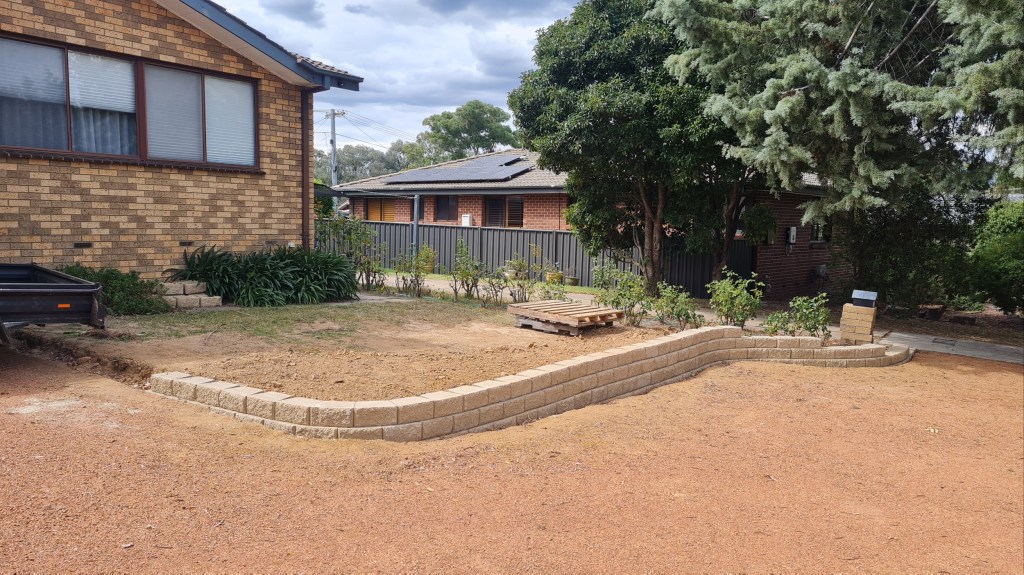
Because I wasn’t already busy enough, I started a project out the front of our house building a small retaining wall to fix up our front yard. So now, not only am I mentally drained, I am also physically drained … I’m not used to this kind of manual work.
I had planned a four-day ride to Chinchilla in Queensland for our annual distance riders get-together. I had booked the time-off and registered my spot. But weeks out, I realised that I just didn’t have a 2,500 km long weekend in me … I am just shattered. I still had the time locked-in, my leave pass was still valid, so a new cunning plan was hatched.
Over the last few months, I’ve been gathering all the equipment to swap out the esky currently mounted on the front of my bike trailer to a little 12-volt fridge and full battery system.
The trick with the fridge is that it needs to be long and narrow so it doesn’t impede the bike when turning; it can’t be too heavy as it’s mounted up front on the a-frame; it’s going to be mounted externally, so it’s going to be in the weather which also means it’s going to be visible and open to opportunistic sticky fingers.
After looking and measuring many fridges I ended up with a budget 30-litre Kings fridge, for the following reasons:
- The weight – expensive fridges are generally a lot heavier, whereas budget models are very plasticy, making them much lighter.
- Shape – it must be narrow, and a considerable number of fridges were much squarer in their footprint ruling them out straight away.
- Cost – you’ll notice this isn’t the first consideration, but it is still certainly a consideration.
- Weather resistance – as the fridge will be out in the open, replacing a cheap fridge if/when it dies from weather exposure or its stolen is much less painful than an expensive fridge … and a cheap fridge is arguably less of a target. Whether you can purchase a cover for the fridge is also a factor … although I have thought about whether it is worth getting a canvas cover made for added weather protection (ensuring that it can still breath).
- Capacity – while larger sounds better, it also means more weight. More capacity also means physically larger, and I want the fridge to tuck into the lines of the trailer rather than sticking out. My old esky was a bit over 30 litres of which a proportion would be taken up by ice. The 30-litre fridge fit perfectly and if in the end I need a bigger fridge the Kings budget line come in a range of capacities and the only difference is the height of the unit so it would still fit my setup.
…
A few weeks back, I pulled off the esky and mounted the fridge, wired it up directly to the bike (switch power) and took it for a couple of hundred-kilometre test ride, and it worked a treat.
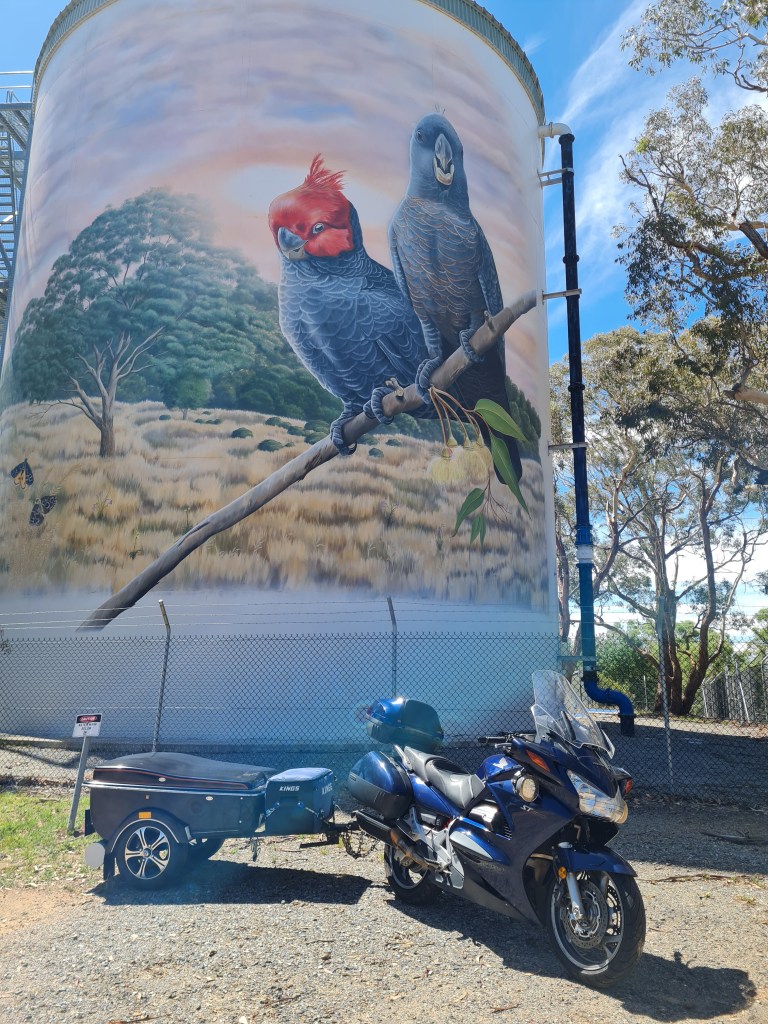
The Kings fridge doesn’t have much insulation in the lid so I did notice that while it was off while I had lunch the fridge didn’t hold the temperature very well as the coolness would seep out easier.
The next step is to mount a full battery system to supply power for the fridge and my other power needs when camping. I didn’t want to mount anything in the trailer, so a battery box needs to be fabricated and mounted under the trailer.
…
Fast forward a few weeks —
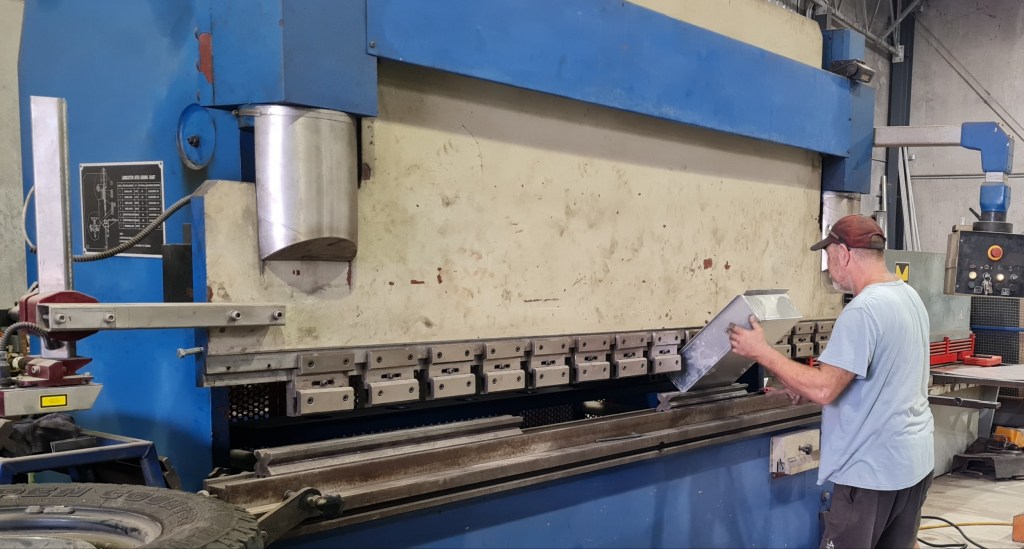
My brother-in-law is a metal fabricator and has three things I don’t have; skill, access to equipment, and know-how. And he is free on my planned weekend away. So a plan was formed … head to the Hunter to get the battery box made, wire the system up, and then head west to camp for a couple of nights to test the setup.
I already had a rough plan of where I wanted to mount the battery. But, taking the fibreglass trailer tub off presented us (okay Jason) with a better / more simple elegant mounting option of making a drop-in battery box supported on all sides by the trailer frame, which would fit the battery perfectly and still allowing just enough room for cabling.
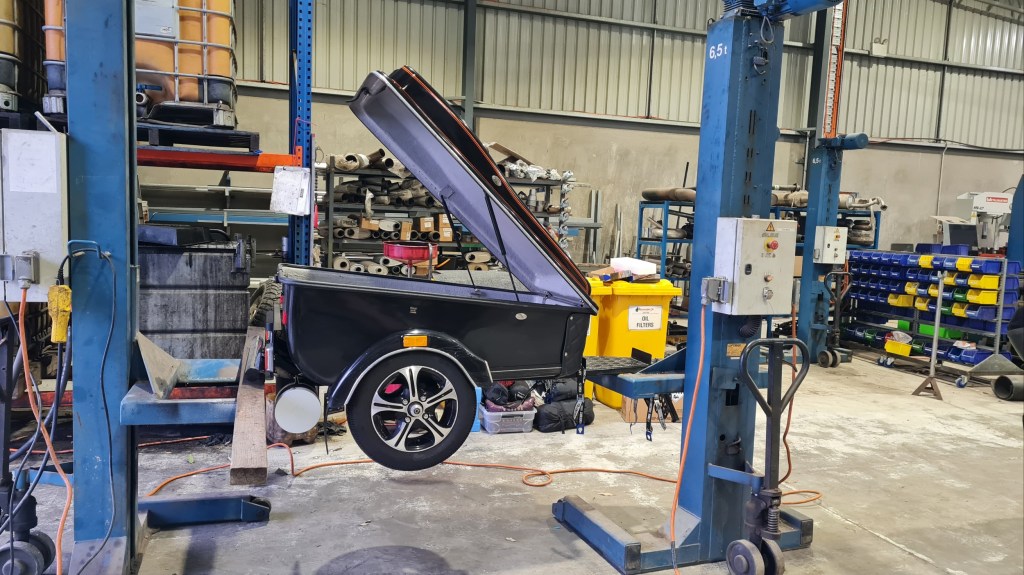
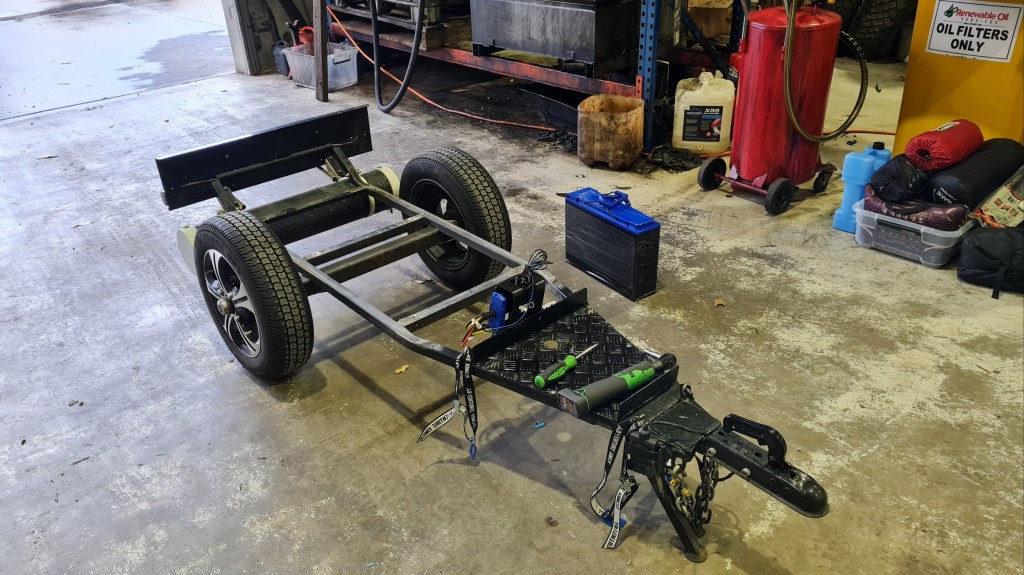
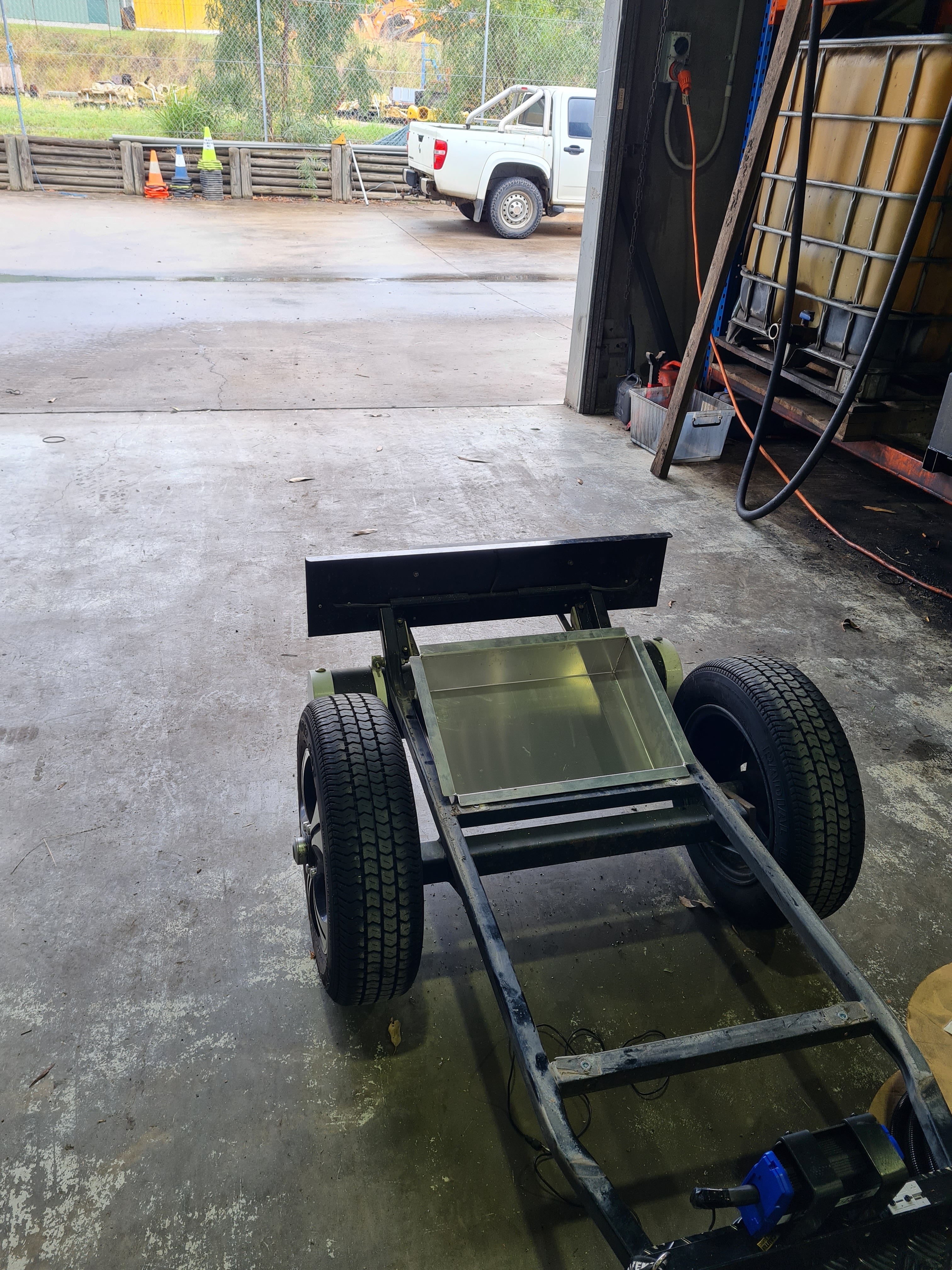
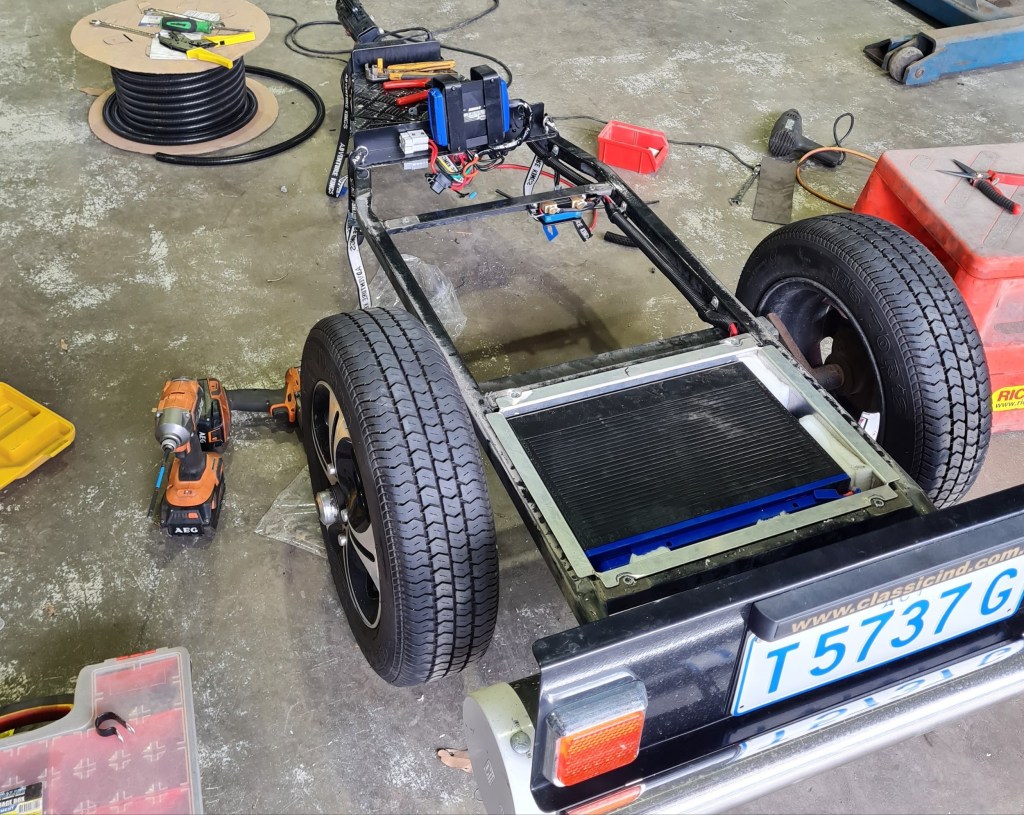
The system consists of:
- Kings 100-amp lithium slimline battery. Slimline as it’s only 110mm deep, so it doesn’t hang down very far below the axle. Lithium as they are considerably lighter. I choose the 100-amp as the next size down, I could find, (in slimline) was 54 amps, and I wanted a bit more reserve than that. I’ve been running a small power station for the last few years and have been caught out a few times, so I’d rather have more capacity than less.
- Kings 25 amp DCDC charger with solar controller. Ideally, a smaller charger to lower the draw on the bike would be better, maybe 15 Amps.
- Victron 300 amp IP67 smart shunt – for Bluetooth battery monitoring. Most monitors need a panel display mounted somewhere, and I don’t have that. The smart shunt is mounted on a cross member protected by a piece of angle iron welded on.
By 1:30pm the trailer was all back together, loaded up, and I was ready to roll out of the workshop.
Like I said – skill, know how, and equipment. Thanks Jason.!
Leading up to this weekend, I’ve been watching Cyclone Alfred heading to the east coast of Australia. For that reason … I’m heading west and away from any potential storms or rain.
Before leaving the Hunter, I booked a spot at the Hill End Village campground for two nights just over 200km away. A place I’ve not been before and meaning to out. And an easy afternoon’s ride.
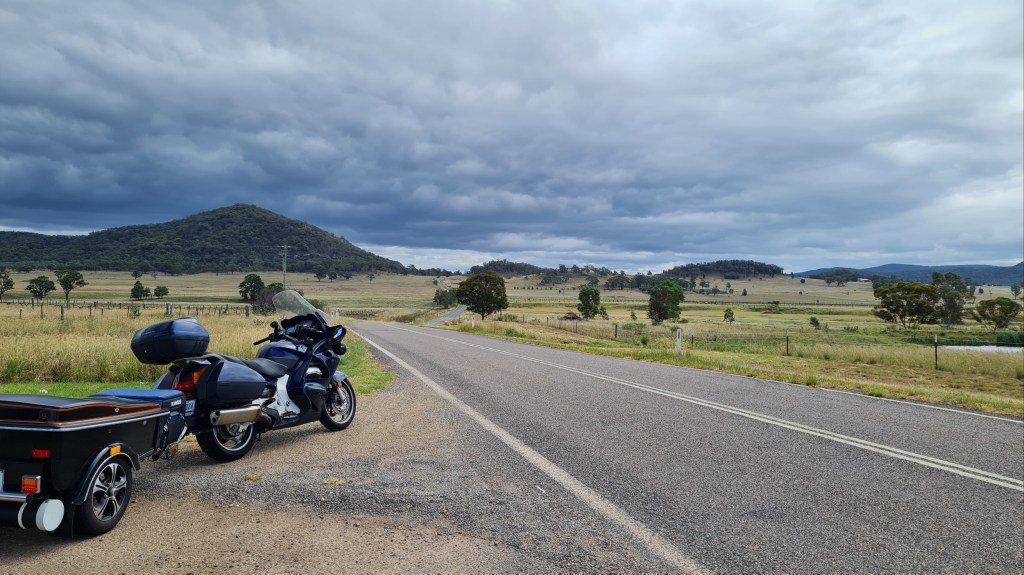
I am always intrigued/amused/frustrated by the number of motorcyclists who continually ask on socials/forums about road conditions, what’s this road or that road like, where should I go, before they venture anywhere. Where has people’s sense of adventure gone.?!
Heading to Bylong, I passed a turnoff to Mudgee, a road I’ve not taken before. A quick stop and check of the map, and it’s generally in the right direction, that was enough for me. What a great flowing road, I’ll certainly be taking this route again.
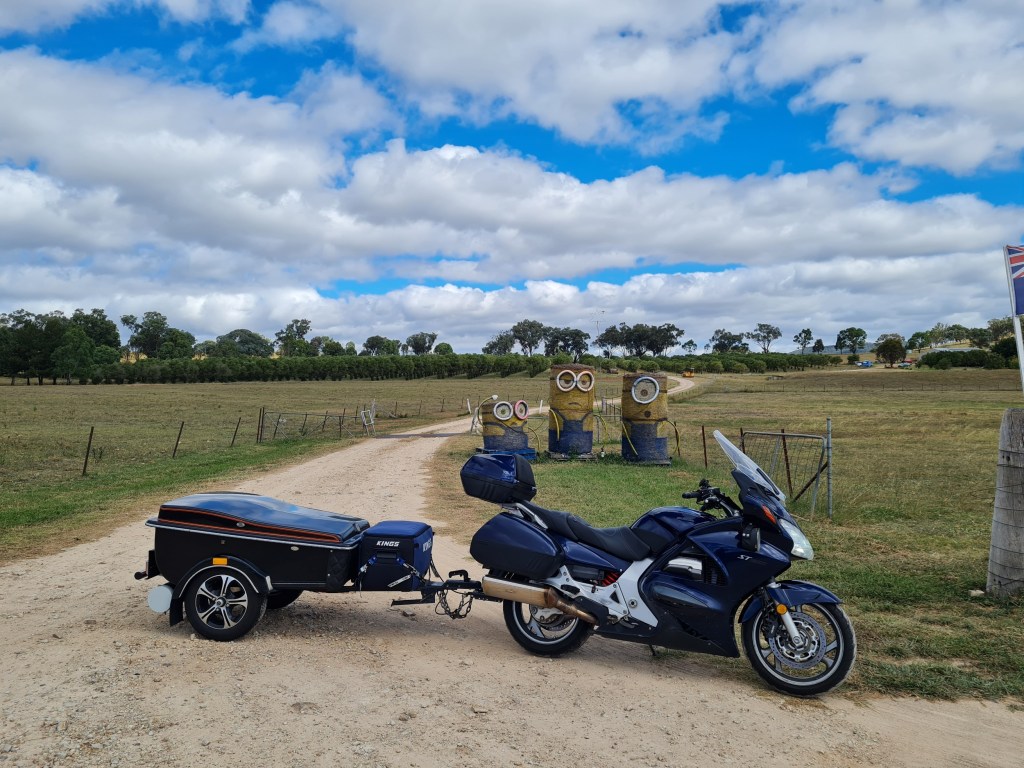
Then, from Mudgee, a narrow winding road takes you to the historic gold mining village of Hill End.
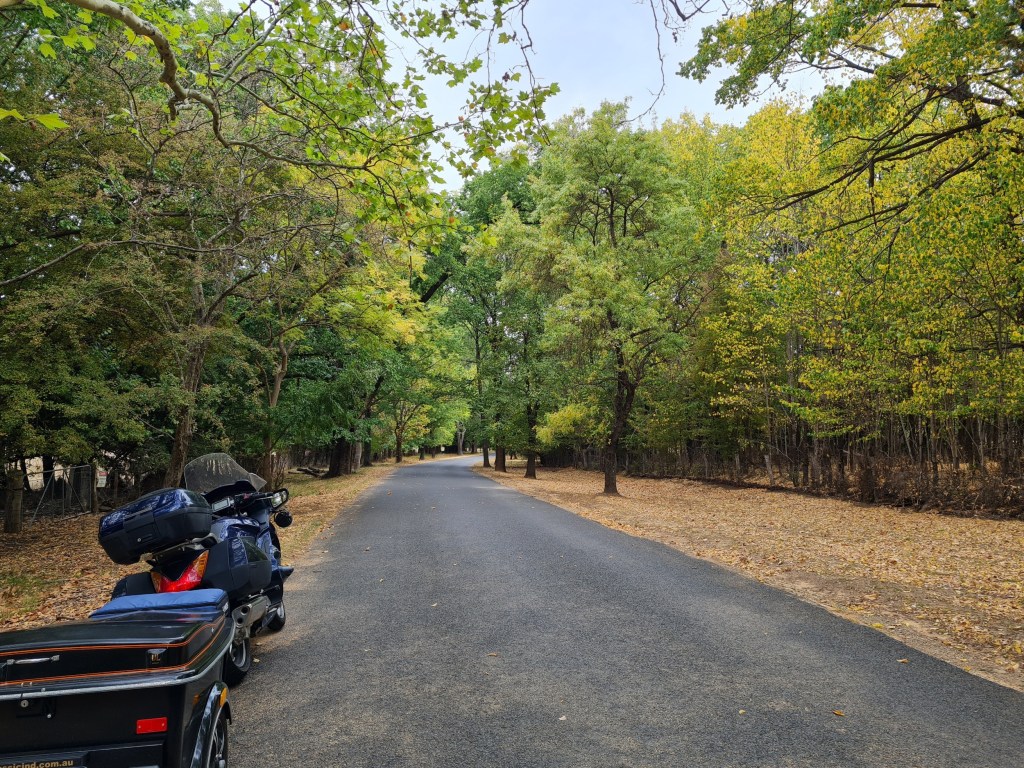
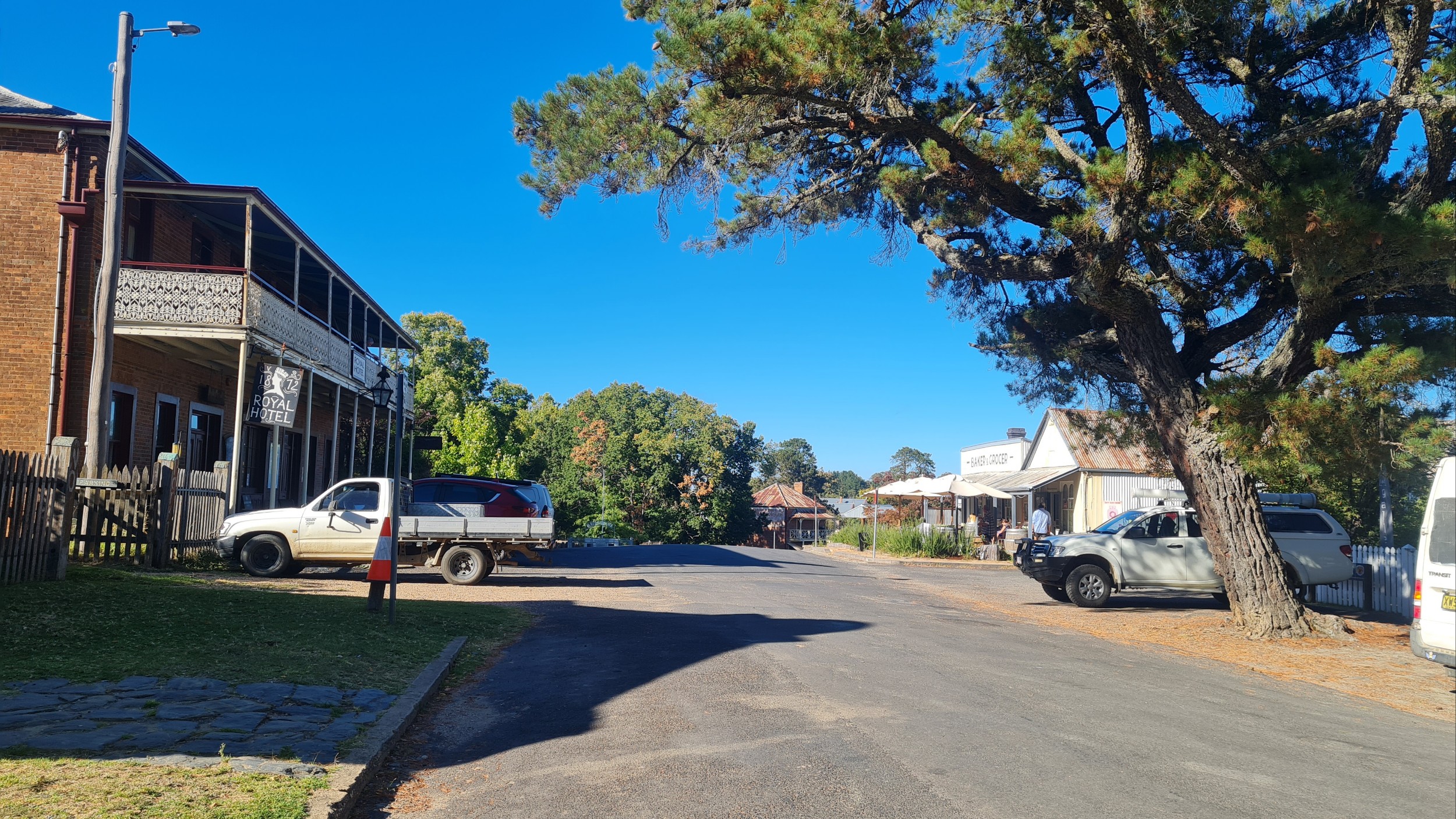
The village campground is a lovely grassed campsite, only a short walk to the cafe and pub. It was also fairly quiet for a Saturday afternoon with a lot of empty spots. Which suited me fine … and by Sunday night, it was really quiet.
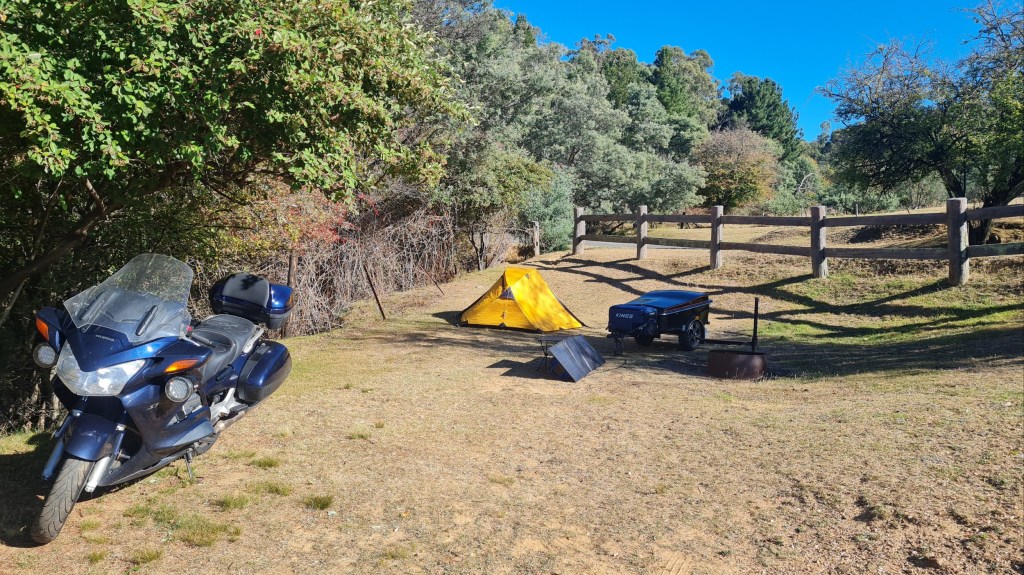
This was a good chance to just sit, read, and take in the surrounds and history of the town.
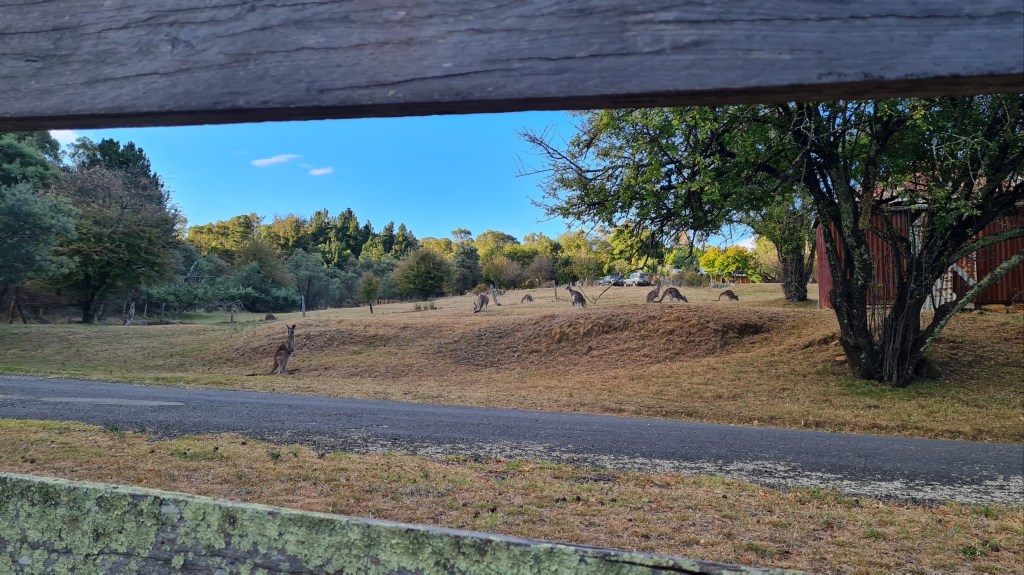
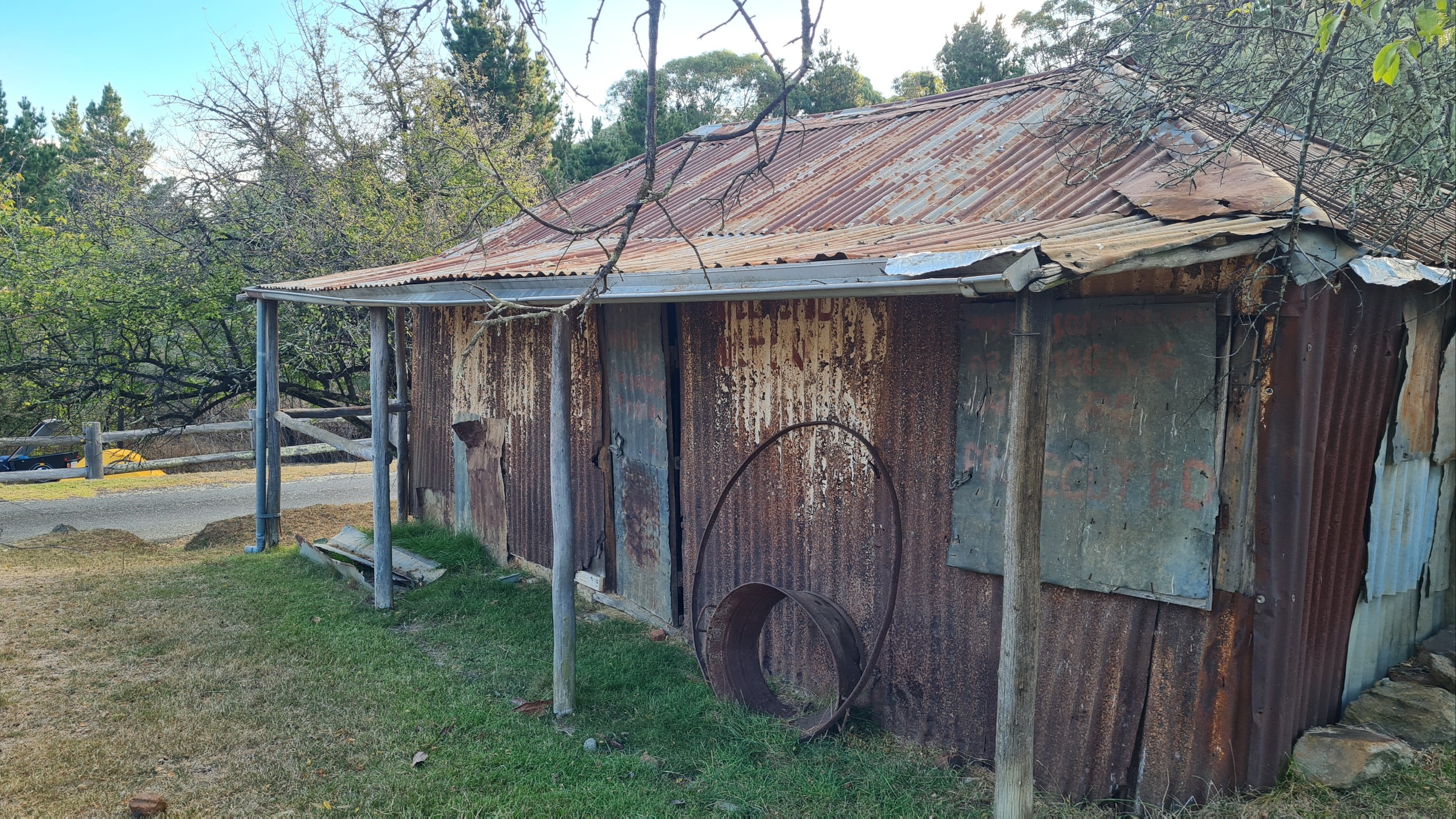
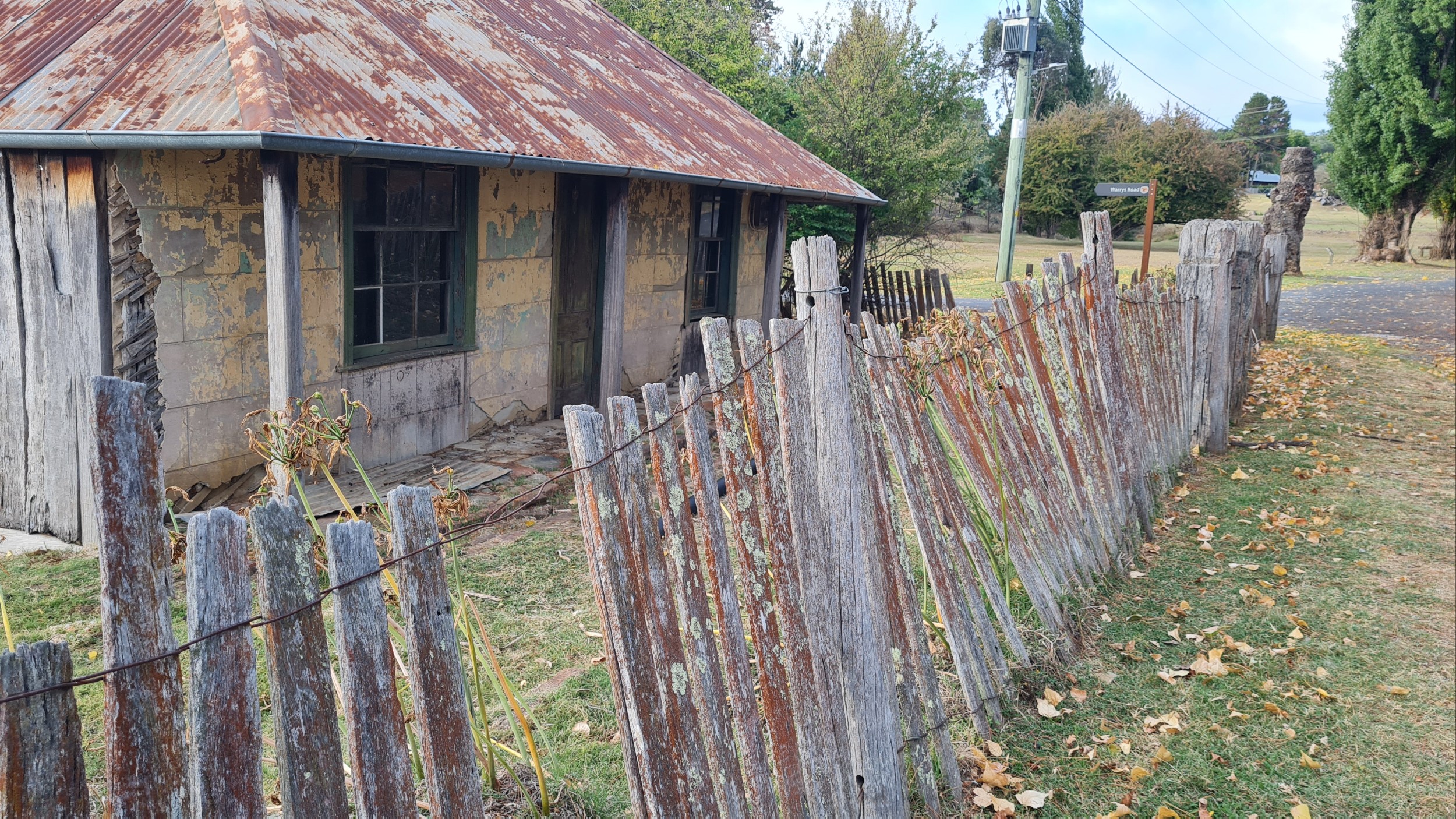
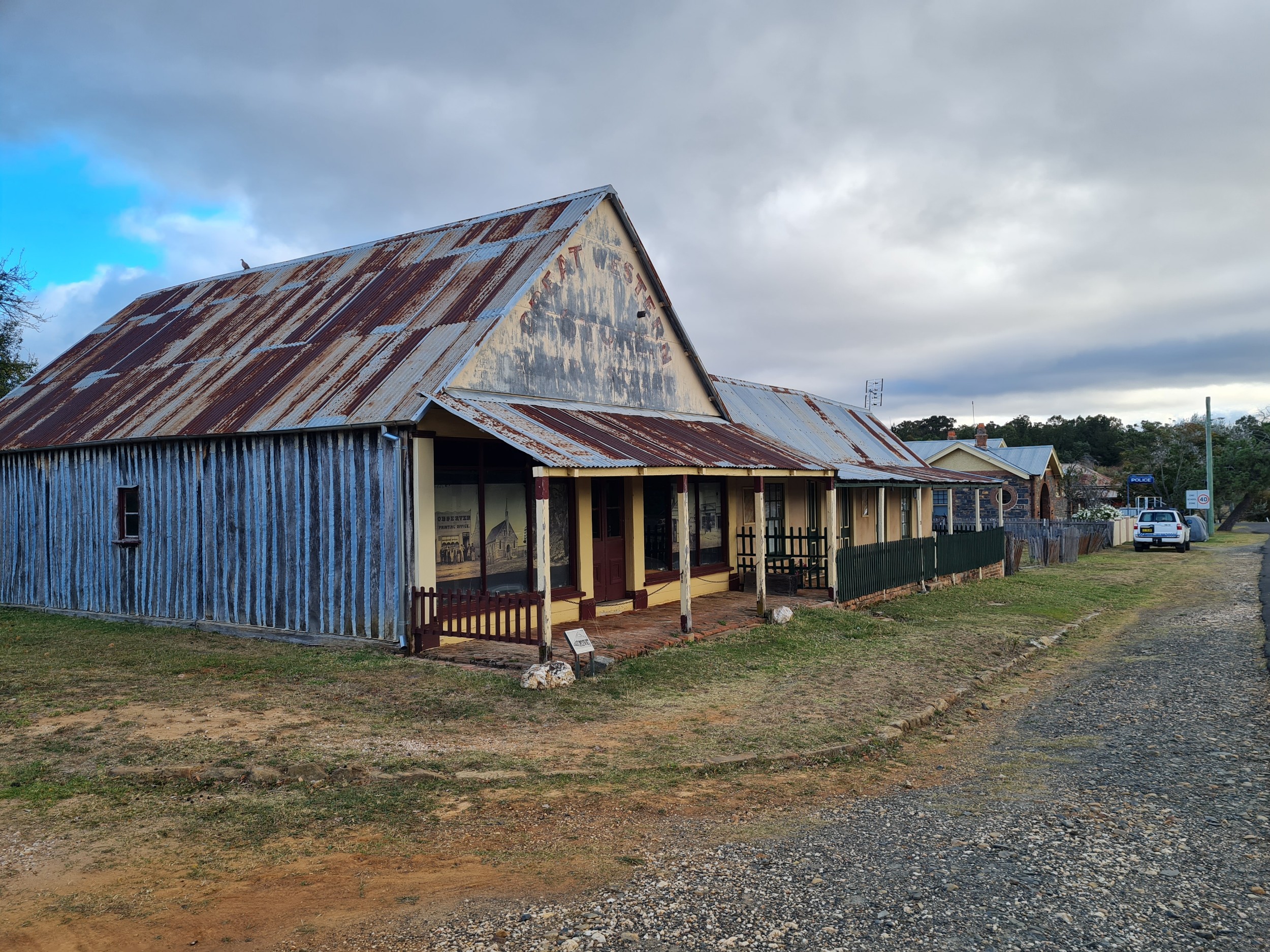
While sitting with a cup of coffee, pairing the battery monitor to my phone I realised that the 15-amp fuse I installed on the bike lead blew (not surprisingly with a 25-amp charger) within minutes of leaving, so the battery didn’t charge at all on my trip. Based on information on the battery when I unpacked it, it only had around 30% charge from factory. I wasn’t 100% sure what charge there was, how much power the fridge would draw, whether I had enough power for my cpap overnight. Therefore, I didn’t run the fridge overnight (I only had drinks and uht milk) just to be sure.
Based on the monitor, the cpap used about 10 amps overnight.
The next morning, I rolled out the solar blanket and it proceeded to charge nicely at up to 6-amps. So, I know that works.
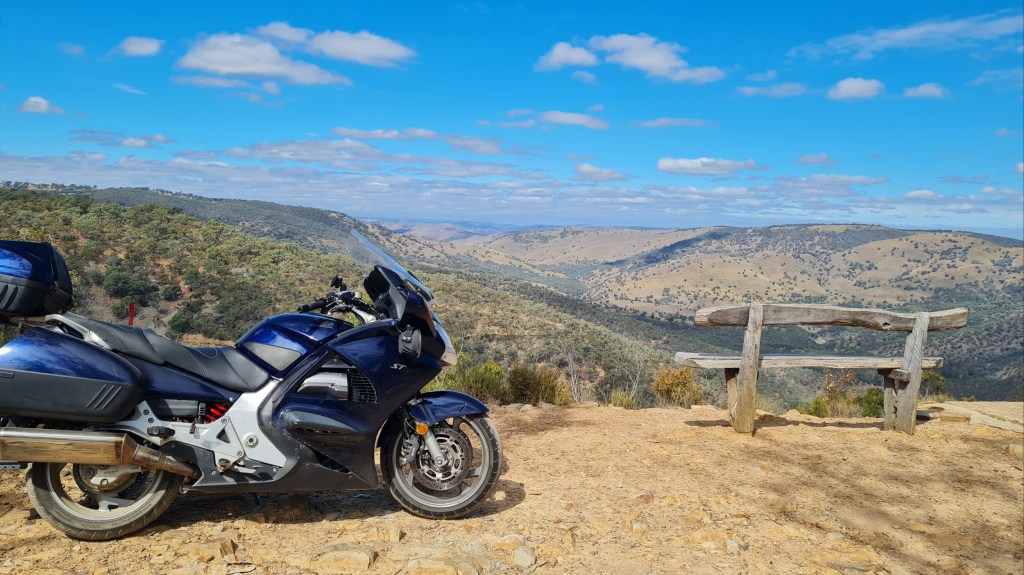
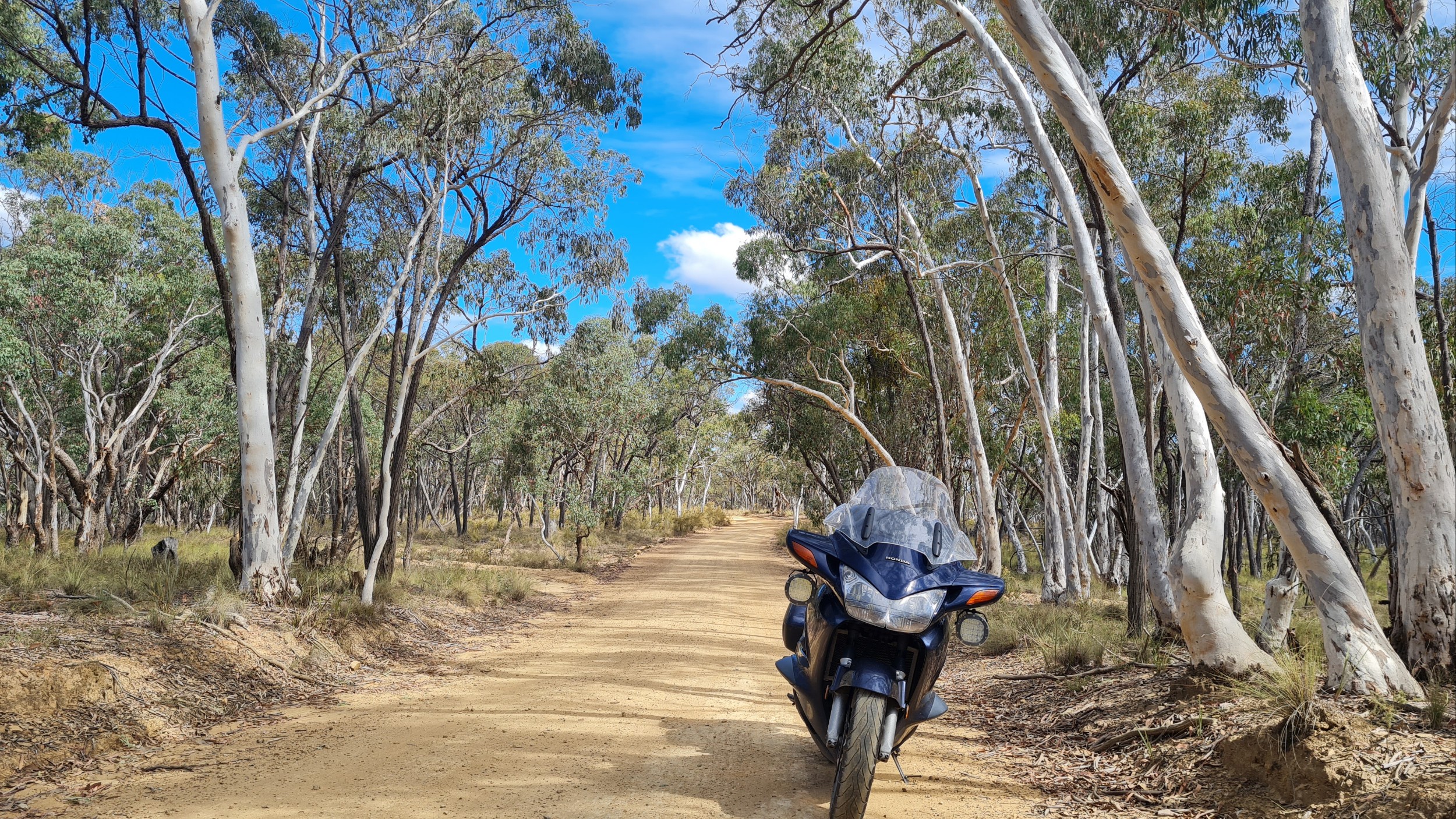
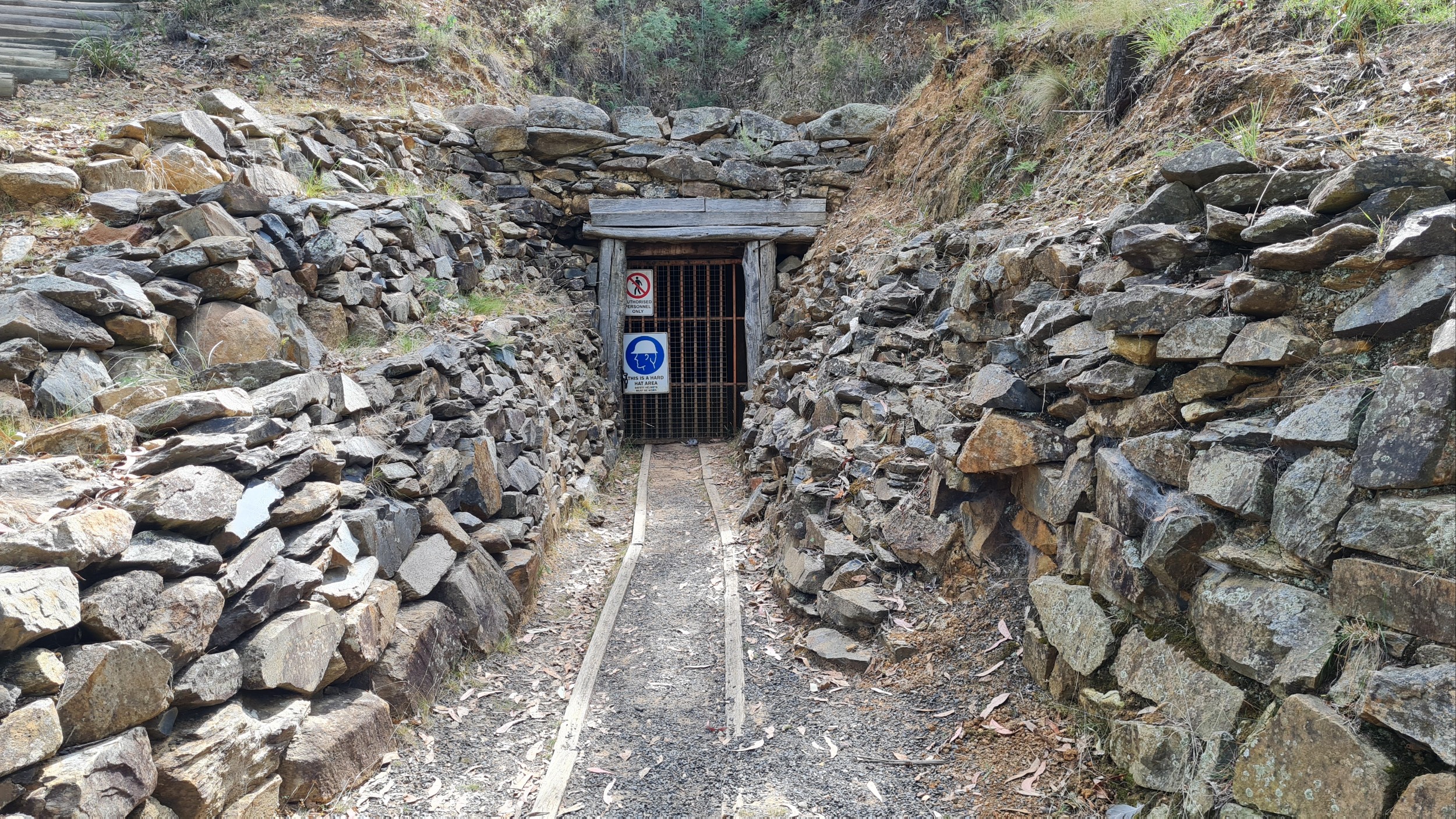
On Sunday I did bugger all. I went for a little ride to a lookout and old mine site, had lunch at the pub, and then found a nice patch of grass under a tree and had a nap.
I am no food connoisseur, and I just don’t get all these cooking shows.! Don’t get me wrong, I like good food … when someone else cooks it. But I’m not going to that trouble to cook a meal. People I’ve talked to who are into this say it is their happy place … not me. For me, food feeds the machine. It’s a chore to prepare and cook. Therefore, when I’m camping, meals are basic, quick, and easy … meal in a bag, meal in a tin, noodles etc. All of which I need minimal stuff for and my Trangia.
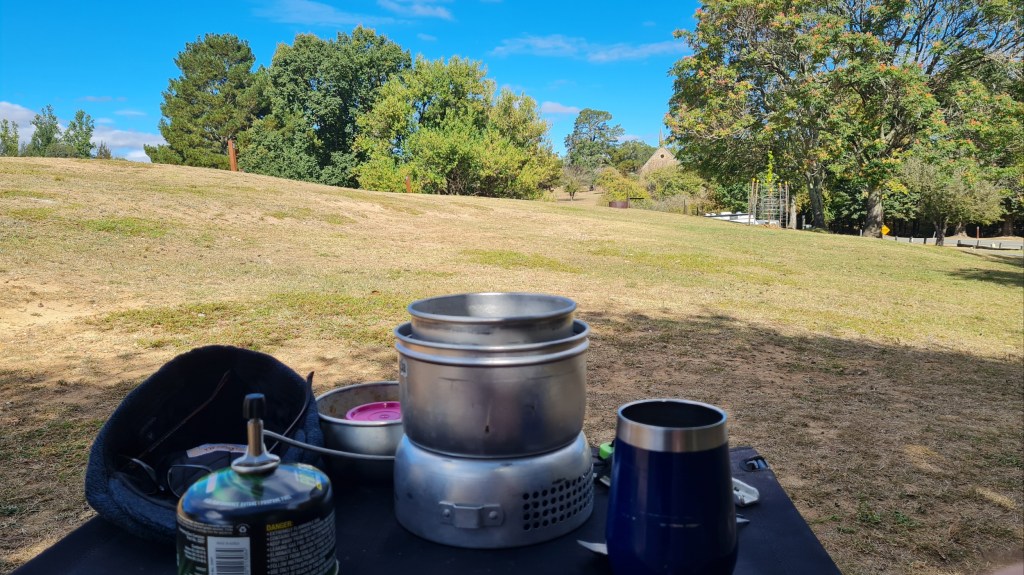
I’ve had my Trangia stove set for over 40 years! I won it in a tent pitching competition way back in 1983 at the Boys Brigade Centenary camp, back before instant tents were a thing. Craig and I had got pitching a 2-man tent down to under 30 seconds from in a bag. We had colour coded poles and sharpened pegs. The whole deal.
The Trangia sat in my cupboard for over a decade unused, primarily because I just didn’t like the metho burner, it was messy and slow. Then I found the gas burner adapter for it over 20-years ago and since then it’s had a lot of use on my camping and motorcycling camping adventures. I have looked at their little kettle a few times, but it’s a bit small and I have a separate billy that fits the gas cartridge which works better for me.
…
Monday morning rolls around and it’s time to pack-up and head home. After some breakfast … I usually just have cereal and coffee, but this trip I grabbed some Uncle Toby’s quick sachets of rolled oats out of the pantry. These are designed for the microwave but add to some boiling water and cook for couple of minutes. Done. I’ll be adding that next time.
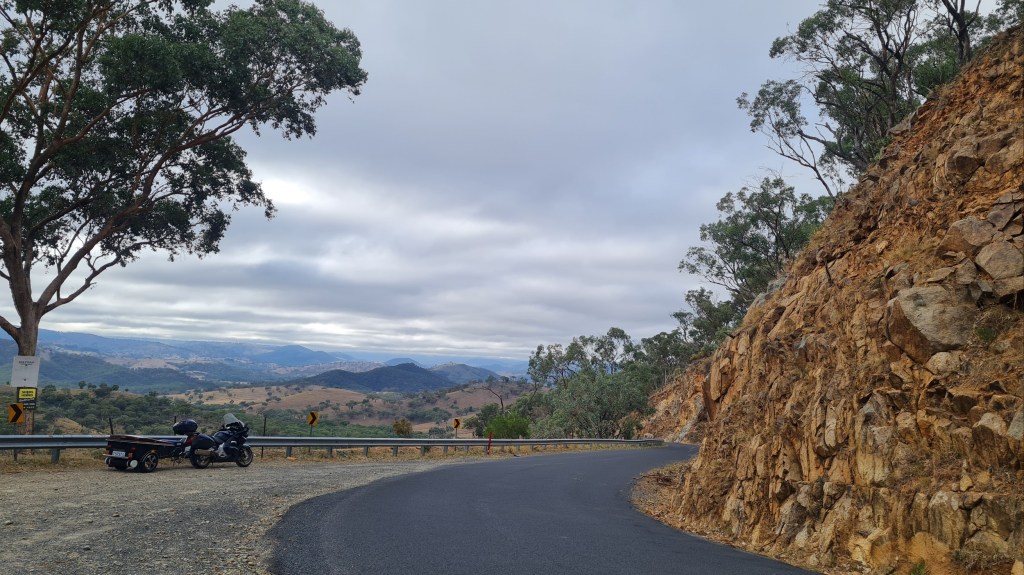
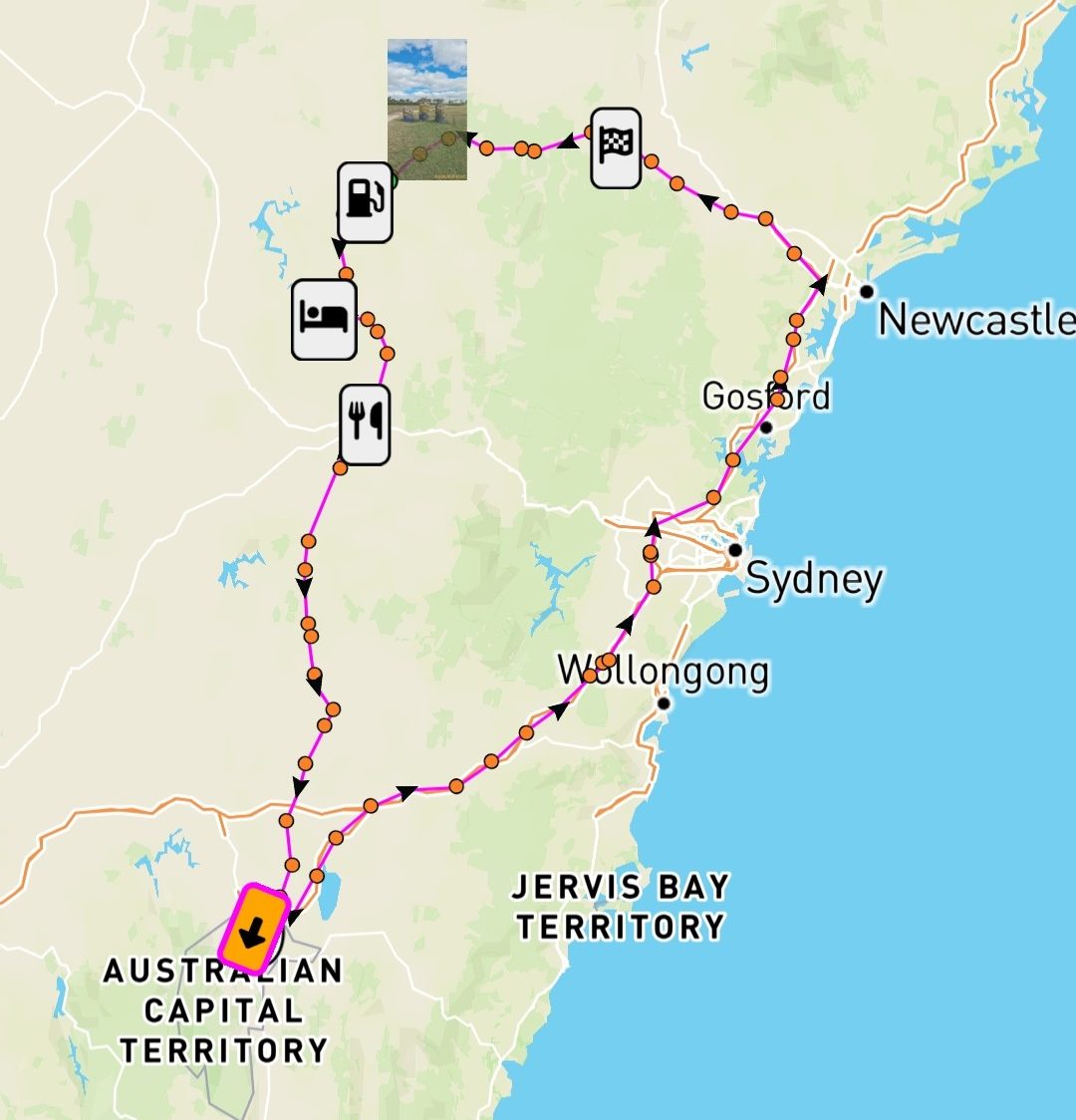
Monitoring the battery charging on the way home and the bike was pumping in about 16 amps (about 230-watts). I wouldn’t want to be drawing too much more than that from the bike, but during the day without any other high current accessories, this should be manageable.
When I got home, the battery was all but fully charged. So this was a great chance for a bit of a test to get a bit of a baseline of power consumption and charging for when we are away.
I ran the fridge at 1oC for 48 hours (days were in the low 30oC and I didn’t pre-cool the fridge which started at around 24oC), and at the end of the 48-hours the fridge had drawn 32.1 amps (or 31% of the battery’s capacity), averaging 0.67 amps per hour (on eco mode).
Then I laid out my 120-watt solar blanket, and it took just over 2 days (mostly full sun) to fully charge the battery.
So, with all my other power needs, I have an easy 3-day supply of power. And for longer periods it should be largely manageable with the solar blanket. I may only need to use the bikes power as a top up rather than all the time, which would be preferable.
I look forward to travelling with the fridge, not having to constantly find more ice, and not having wet mushy soggy food.
Overall, a great outcome.!


 Zed14
Zed14 
beautiful pics and I love the little trailer and fridge!
LikeLike
Thanks. I love my little trailer and we are working on a big trip in the next couple of years.
LikeLike
Pingback: Power Stations – Powering your moto-camping adventure | Zed14
Nice little setup, Glen.
How’s the ST compared to the Zed?
LikeLike
The way I explain it is that they are both in the sports routing category – the zed is firmly at the sports end of the continuum and the ST at the other end. Both great for different purpses
LikeLike